

Quick answer: AI data readiness is the practice of discovering, classifying, and governing every dataset AI can touch, before it becomes a liability. Sentra, the AI data readiness and governance platform, has been named a 2026 Intellyx Digital Innovator Award winner. In a market where enterprises are deploying AI faster than they're governing the data underneath it, this recognition reflects what security and data teams are both asking for; a platform that makes data AI-ready at petabyte scale, without moving sensitive data out of the environment to do it.
What the Intellyx Digital Innovator Award Actually Means
Intellyx, an independent analyst firm focused on enterprise digital transformation, grants the Digital Innovator Award to companies driving genuine technological value. For Sentra, this recognition arrives at a critical inflection point. While enterprises have prioritized AI infrastructure and governance frameworks, they’ve largely neglected a third, essential pillar. Most organizations still lack visibility into what their AI can actually access; including sensitive, over-permissioned, or redundant data that is quietly feeding models it shouldn't be near.
Why AI Is a Data Problem and Why Most Organizations Haven't Solved It Yet
I've spent enough time inside enterprise security programs to see the same pattern repeat. Teams race to stay at the cutting-edge and quickly build out infrastructure for the latest new technological breakthrough. WE are now in the midst of a frantic race to leverage AI boldly. Teams have all deployed copilots, stood up RAG pipelines, etc. Then comes the awkward moment when someone asks "What data can this thing actually reach?" and the room goes quiet.
According to Gartner's 2025 predictions, 60% of AI projects will be abandoned through 2026 when the underlying data isn't AI-ready. That rate is already at 42% among US enterprises today. The bottleneck isn't models or compute. It's data. Specifically, data that hasn't been discovered, classified, and governed before AI systems started querying it.
The four problems converging on every organization right now: AI and copilots that inherit whatever permissions already exist; data sprawl across cloud, SaaS, and on-premises environments; overpermissioning that turns a misconfigured service account into an AI exposure; and ungoverned redundant, obsolete, and toxic (ROT) datasets that were never cleaned up and are now in scope for every AI query.
The blast radius of a misconfigured permission is no longer a future breach scenario. It's an AI response surfacing the wrong content to the wrong person today.
What AI Data Readiness Actually Requires and Sentra Delivers
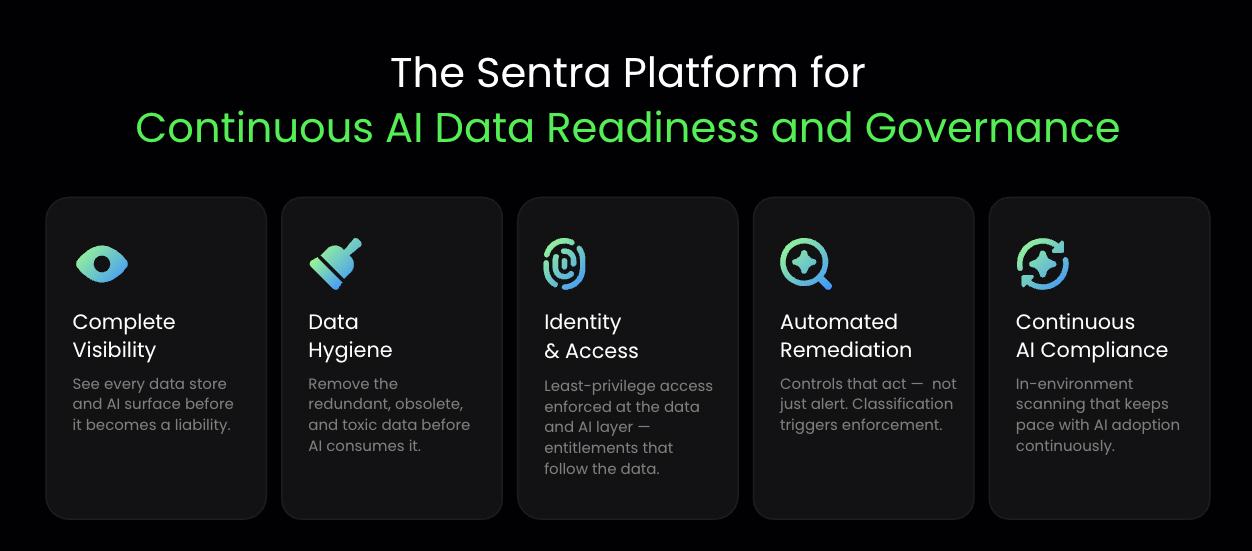
AI data readiness is not a scan. It's not a quarterly audit. It's five integrated capabilities running continuously:
- discovery and classification across every environment
- data lifecycle hygiene and ROT (redundant, obsolete, toxic) removal before bad data feeds AI
- identity and access governance that maps every path where AI inherits excess permission
- automated enforcement that acts on findings without waiting for a human ticket
- continuous compliance across GDPR, HIPAA, CCPA, the EU AI Act, and all regulatory frameworks
Sentra delivers all five as one platform. AI Data Readiness and Governance at Enterprise Scale and Speed.
The architecture is what makes this possible at scale. Sentra's managed SaaS orchestrates on-demand scanners that run inside the customer environment. The analysis happens in your account. Only metadata — labels, signals, policy — comes back to the platform. Sensitive data never leaves your environment, which means zero data egress to attest to at audit, zero third-party data retention risk, and a single deployment that spans your full multi-cloud footprint without the 10+ outpost clusters that alternative approaches require.
In a Fortune 500 head-to-head evaluation, Sentra scanned 9 petabytes in under 72 hours with greater than 98% classification accuracy, validated by an independent audit team hired by the customer, at approximately $40,000 per year to scan 100 petabytes. That's 10x lower operational cost than comparable approaches because there are no idle clusters, no manual overhead, and no hidden infrastructure compounding the contract price.
Sentra Wins Fortune 500 Customer Bake-Off
Why the Intellyx Award Matters at This Specific Moment
Gartner forecasts that AI spending allocated to data readiness will increase 7x from 2025 to 2029. The AI data readiness market is projected to grow from $2.1 billion today to $15.5 billion by 2030 — a 65% CAGR, making it the fastest-growing segment in the AI spending forecast. The money is following the bottleneck, not the buildout.
Gartner's 2026 research puts it plainly. As AI models become increasingly commoditized, competitive advantage will come from proprietary data and world-class data security is what allows organizations to leverage that data for AI in ways competitors cannot.
The Intellyx Digital Innovator list for Spring 2026 includes vendors across observability, cloud infrastructure, AI governance, and security. Being recognized here reflects what the analyst community is seeing in enterprise transformation priorities. AI data readiness is no longer a security team concern. It's a strategic requirement for every AI project.
"Organizations are deploying AI faster than they're governing the data underneath it," said Yoav Regev, CEO and Co-Founder of Sentra. "This recognition reflects the urgency both security and data teams are bringing to this problem and the fact that a platform purpose-built to solve it at enterprise scale exists today."
The question I keep hearing from CISOs and security engineers isn't 'Should we govern our AI data?' It's 'How do we actually do it without slowing AI deployment down?'" That's exactly the problem the Sentra AI Data Readiness platform is built to solve; continuous readiness, not a one-time project.
To Make Your Data AI-Ready
Sentra is an AI data readiness and governance platform built for continuous classification, lifecycle governance, and identity-aware data security at enterprise scale. To see what Sentra finds in your environment from the very first scan across cloud, SaaS, and on-premises; visit sentra.io.


